
Mastering Agile Project Management: Strategies for Success
In today’s fast-paced business environment, the ability to adapt quickly and deliver value consistently is paramount. Traditional project management methodologies, often characterized by rigid plans and long development cycles, frequently struggle to keep up with evolving requirements and market demands. This is where Agile Project Management steps in, offering a flexible, iterative, and highly collaborative approach that has revolutionized how teams deliver projects across various industries. Whether you’re a seasoned project manager, a team lead, or an aspiring professional, understanding and implementing effective Agile strategies can significantly boost your project success rates and foster a more dynamic, responsive work culture.
The core philosophy of Agile is centered around delivering value to the customer through continuous iteration and feedback. It’s not just a methodology; it’s a mindset that prioritizes individuals and interactions over processes and tools, working software over comprehensive documentation, customer collaboration over contract negotiation, and responding to change over following a plan. This article will delve deep into the world of Agile Project Management, exploring its fundamental principles, popular frameworks like Scrum and Kanban, and practical strategies to implement it effectively within your organization. We will uncover how Agile can transform your project delivery, enhance team productivity, and ultimately lead to greater customer satisfaction.
What is Agile Project Management?
At its heart, Agile Project Management is an iterative approach to delivering projects in a highly flexible and interactive manner. Unlike the linear, sequential ‘waterfall’ model, Agile breaks down projects into smaller, manageable chunks called iterations or sprints. Each iteration typically lasts between one to four weeks and results in a potentially shippable increment of the product. This allows teams to continuously gather feedback, adapt to changes, and deliver value incrementally, rather than waiting until the very end of a long project cycle.
Advertisements
The Agile Manifesto: Guiding Principles
The foundation of Agile lies in the Agile Manifesto, penned in 2001 by seventeen software developers. While initially focused on software development, its four core values and twelve supporting principles are universally applicable to any project striving for flexibility, collaboration, and customer focus:
- Individuals and interactions over processes and tools
- Working software over comprehensive documentation
- Customer collaboration over contract negotiation
- Responding to change over following a plan
These values emphasize human interaction, practical output, partnership with customers, and adaptability. The twelve principles further elaborate on these values, advocating for early and continuous delivery, welcoming changing requirements, frequent delivery of working software, sustainable development pace, daily collaboration, trust in motivated individuals, face-to-face conversations, working software as the primary measure of progress, technical excellence, simplicity, self-organizing teams, and regular reflection for improvement. Embracing these principles is crucial for successful Agile Project Management.
Key Benefits of Adopting Agile
The widespread adoption of Agile Project Management is not without reason. Organizations across various sectors have reported significant advantages:
- Increased Flexibility and Adaptability: Agile’s iterative nature allows teams to respond quickly to changing requirements and market conditions, reducing the risk of delivering an outdated or irrelevant product.
- Faster Time to Market: By delivering working increments frequently, businesses can get valuable products into the hands of users sooner, enabling early feedback and quicker realization of benefits.
- Enhanced Customer Satisfaction: Continuous customer involvement and feedback loops ensure that the final product closely aligns with user needs and expectations.
- Improved Team Collaboration and Morale: Agile promotes self-organizing, cross-functional teams and open communication, leading to greater ownership, engagement, and a more positive work environment.
- Higher Quality Products: Regular testing, feedback, and continuous improvement cycles inherent in Agile methodologies lead to fewer defects and a higher quality end product.
- Reduced Risk: Breaking down projects into smaller iterations allows for early identification and mitigation of risks, preventing small issues from escalating into major problems.
- Greater Transparency: Daily stand-ups, visible progress tracking (like Kanban boards), and frequent reviews provide stakeholders with a clear understanding of project status and progress.
Popular Agile Frameworks and Methodologies
While Agile is a broad philosophy, several frameworks provide specific guidelines and practices for its implementation. The two most widely used are Scrum and Kanban.
Scrum: The Most Popular Agile Framework
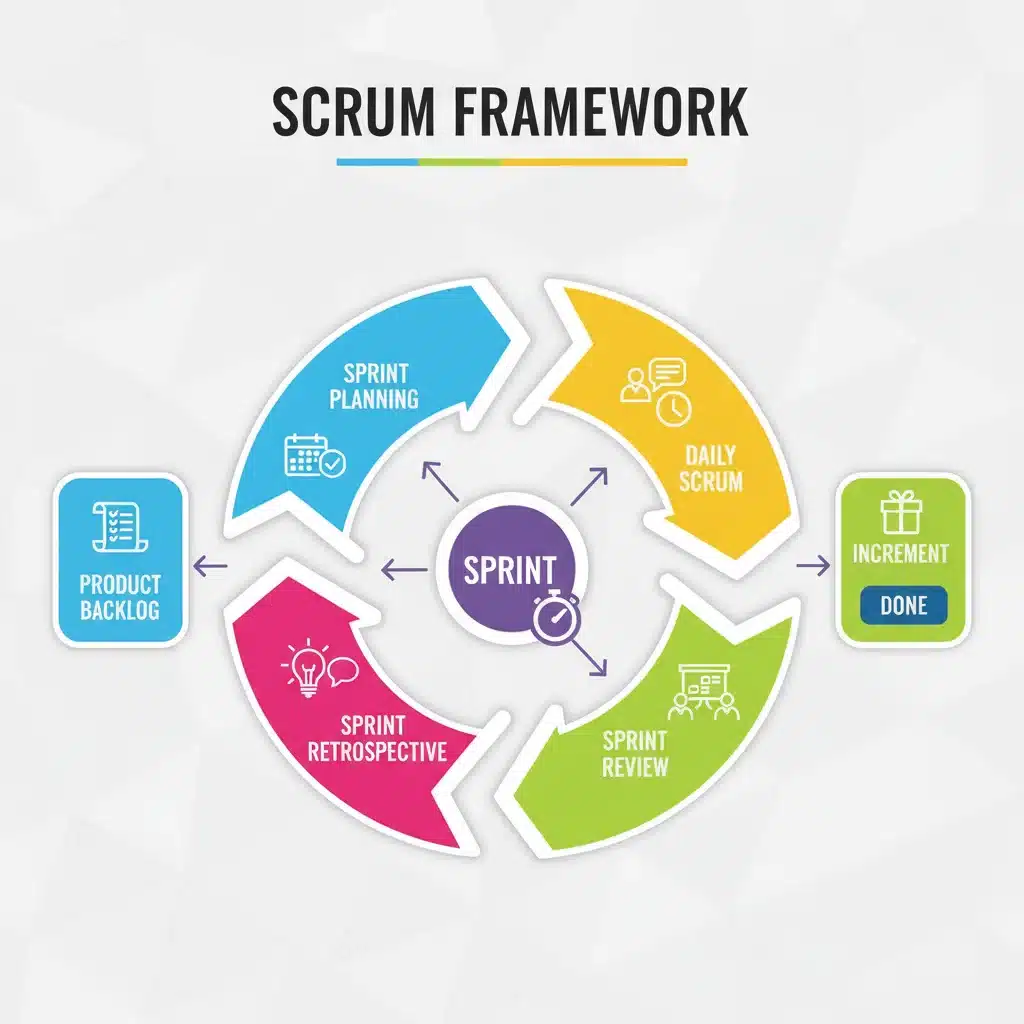
Scrum is an iterative, incremental framework for developing, delivering, and sustaining complex products. It’s highly prescriptive, defining specific roles, events, and artifacts. The heart of Scrum is the ‘Sprint,’ a time-boxed iteration (usually 1-4 weeks) during which a ‘Scrum Team’ works to complete a set of ‘Product Backlog Items’.
Key Components of Scrum:
- Roles:
- Product Owner: Represents the voice of the customer, defines and prioritizes the ‘Product Backlog’.
- Scrum Master: Facilitates Scrum events, removes impediments, and coaches the team on Scrum principles.
- Development Team: Self-organizing, cross-functional individuals responsible for delivering the product increment.
- Events:
- Sprint Planning: The team plans the work to be performed in the upcoming sprint.
- Daily Scrum (Stand-up): A short daily meeting for the Development Team to synchronize activities and plan for the next 24 hours.
- Sprint Review: The team demonstrates the completed work to stakeholders and gathers feedback.
- Sprint Retrospective: The team inspects how the last sprint went regarding individuals, interactions, processes, and tools, and identifies improvements for the next sprint.
- Artifacts:
- Product Backlog: An ordered list of everything that might be needed in the product.
- Sprint Backlog: The set of Product Backlog items selected for the current sprint, plus the plan for delivering them.
- Increment: The sum of all Product Backlog items completed during a sprint and all previous sprints, potentially shippable.
Scrum’s structured yet flexible nature makes it an excellent choice for teams needing a clear framework to guide their Agile Project Management efforts.
Kanban: Visualizing Workflow
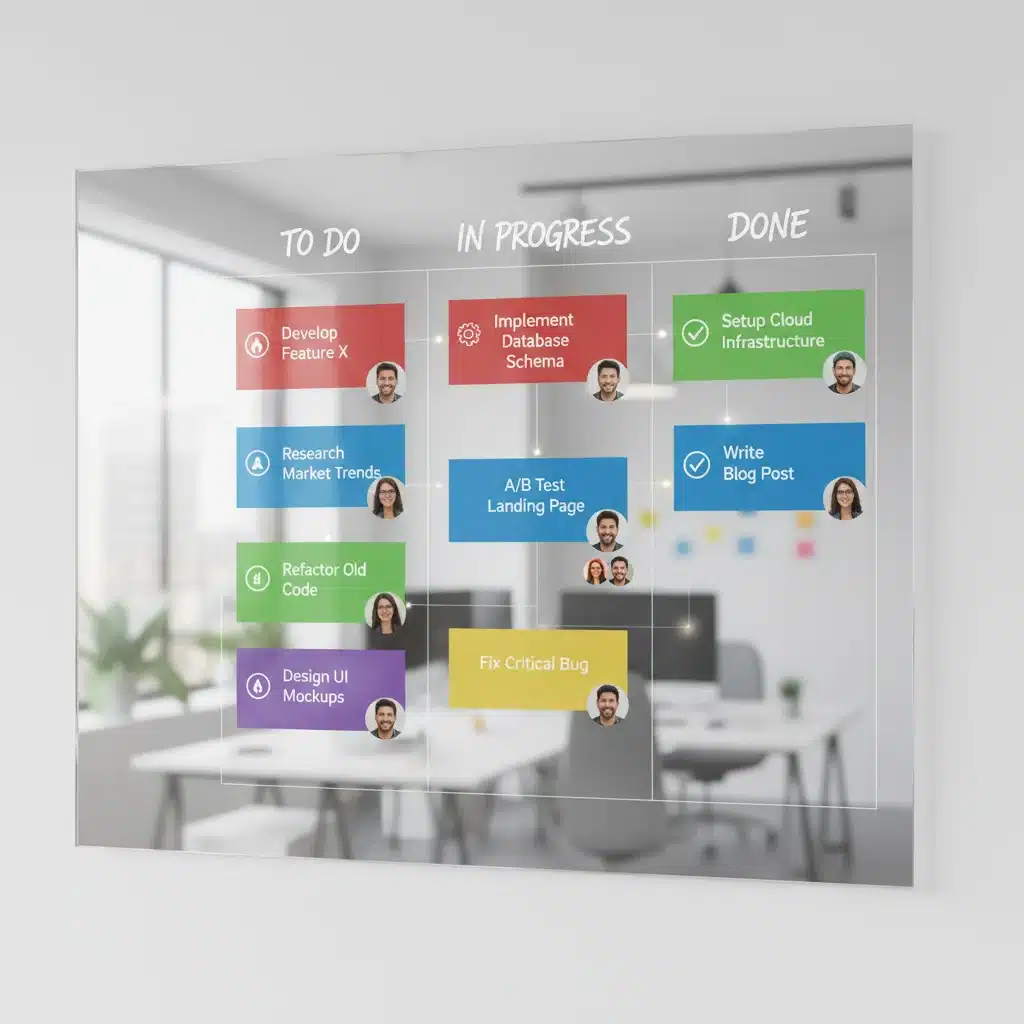
Kanban, originating from Toyota’s production system, focuses on visualizing workflow, limiting work in progress (WIP), and maximizing efficiency. It’s less prescriptive than Scrum, making it highly adaptable to existing processes. The core tool in Kanban is the Kanban board, which visually represents the workflow and the status of tasks.
Key Principles of Kanban:
- Visualize the Workflow: Use a Kanban board to make all work visible, typically with columns representing stages like ‘To Do,’ ‘In Progress,’ and ‘Done.’
- Limit Work in Progress (WIP): Set explicit limits on the number of items that can be in progress at each stage to reduce multitasking and improve focus.
- Manage Flow: Monitor and improve the flow of work through the system, identifying and eliminating bottlenecks.
- Make Process Policies Explicit: Clearly define the rules and criteria for moving work from one stage to the next.
- Implement Feedback Loops: Regularly review and adjust the process based on performance and outcomes.
- Improve Collaboratively, Evolve Experimentally: Encourage continuous, evolutionary improvement through scientific methods.
Kanban is particularly effective for maintenance projects, support teams, or any scenario where work arrives continuously and priorities can shift frequently. It provides a powerful visual tool for managing the flow of work and optimizing throughput, making it a valuable approach in Agile Project Management.
Implementing Agile Project Management: Best Practices
Adopting Agile goes beyond simply choosing a framework; it requires a cultural shift and adherence to best practices to truly reap its benefits.
1. Foster a Collaborative and Transparent Culture
Agile thrives on open communication and trust. Encourage team members to share ideas, concerns, and progress openly. Transparency in project status, challenges, and decisions builds trust and empowers teams to self-organize effectively. Daily stand-ups, regular reviews, and accessible information radiators (like physical or digital boards) are essential for maintaining this transparency.
2. Empower Self-Organizing, Cross-Functional Teams
Agile teams are most effective when they are empowered to make decisions about how they will accomplish their work. Foster an environment where teams can determine the best way to achieve their sprint goals without micromanagement. Ensure teams are cross-functional, meaning they have all the necessary skills (development, testing, design, etc.) to complete a project increment from start to finish without external dependencies.
3. Prioritize Ruthlessly with a Clear Product Backlog
A well-maintained and prioritized Product Backlog is the backbone of successful Agile Project Management. The Product Owner must work closely with stakeholders to ensure the backlog reflects the highest business value items. Prioritization should be continuous, adapting to new information and feedback. Tools for backlog management can greatly assist in this process.
4. Embrace Iterative Development and Continuous Feedback
The iterative nature of Agile means delivering small, functional increments frequently. This allows for constant feedback from stakeholders and end-users. Integrate feedback loops at every stage – from sprint reviews to user acceptance testing – and be prepared to adapt your plans based on this input. This continuous learning cycle is what makes Agile so powerful.
5. Focus on Delivering Working Software Frequently
The ultimate measure of progress in Agile is working software (or a functional product increment). Teams should strive to deliver a potentially shippable product at the end of each sprint. This focus on tangible output ensures that value is consistently being created and reduces the risk of long development cycles yielding little to no usable product.
6. Conduct Regular Retrospectives for Continuous Improvement
Agile is synonymous with continuous improvement. Sprint Retrospectives are dedicated events for teams to reflect on what went well, what could be improved, and what actions they will take to enhance their processes for the next sprint. These sessions are crucial for evolving team dynamics, refining workflows, and optimizing overall productivity in Agile Project Management.
7. Utilize Appropriate Tools and Technology
While Agile emphasizes individuals and interactions over tools, the right tools can significantly support Agile practices. Project management software like Jira, Trello, Asana, or Monday.com can help with backlog management, task tracking, sprint planning, and visualization of progress. Collaboration tools like Slack or Microsoft Teams facilitate communication. Choose tools that fit your team’s specific needs and integrate seamlessly into your workflow.
8. Manage Stakeholder Expectations and Involvement
Successful Agile Project Management requires active stakeholder involvement. Educate stakeholders on Agile principles and manage their expectations regarding iterative delivery and evolving requirements. Regular communication, sprint reviews, and demonstrations ensure they are informed and can provide valuable input throughout the project lifecycle.
Challenges in Agile Adoption and How to Overcome Them
While the benefits of Agile are compelling, organizations often face challenges during its adoption. Recognizing these hurdles and planning for them can smooth the transition.
- Resistance to Change: Employees and management accustomed to traditional methods may resist the shift to Agile. Overcome this by providing comprehensive training, clear communication about the benefits, and involving key influencers in the transition process. Start with small, pilot projects to demonstrate success.
- Lack of Understanding: A superficial understanding of Agile can lead to ‘Agile in name only’ (AINO) implementations. Invest in proper training and coaching from experienced Agile practitioners. Emphasize the mindset shift, not just the practices.
- Inadequate Leadership Support: Agile requires strong leadership support to remove organizational impediments and champion the cultural change. Leaders must understand their role in empowering teams and fostering an Agile environment.
- Difficulty in Scaling Agile: As organizations grow, scaling Agile to multiple teams and larger projects can be complex. Frameworks like SAFe (Scaled Agile Framework), LeSS (Large-Scale Scrum), or Scrum@Scale can help, but require careful planning and implementation.
- Estimating and Budgeting in Agile: Traditional fixed-price, fixed-scope contracts are challenging in Agile. Shift towards value-based contracts, flexible budgeting, and continuous forecasting. Focus on delivering minimum viable products (MVPs) and iteratively building upon them.
- Distributed Teams: Managing Agile across geographically dispersed teams can be tricky. Leverage collaboration tools, establish clear communication protocols, schedule overlapping work hours, and foster a strong sense of team cohesion despite distance.
- Technical Debt: The pressure to deliver quickly can sometimes lead to accumulating technical debt. Emphasize technical excellence, continuous refactoring, and dedicate time within each sprint to address quality and maintainability.
The Future of Agile Project Management
Agile Project Management is not a fad; it’s an evolving approach that continues to adapt to new technologies and business landscapes. We are seeing a growing integration of Agile with other methodologies and concepts:
- DevOps Integration: Agile focuses on continuous delivery, and DevOps extends this by automating the entire software delivery pipeline, from development to operations. The synergy between Agile and DevOps creates a highly efficient and responsive development ecosystem.
- AI and Machine Learning: AI can assist in optimizing Agile processes, such as predicting sprint velocity, identifying potential bottlenecks, or even automating routine tasks, allowing teams to focus on higher-value activities.
- Hybrid Approaches: Many organizations are finding success with hybrid models that combine elements of Agile with traditional project management, especially for projects with both predictable and exploratory components.
- Business Agility: The concept of Agile is expanding beyond IT departments to encompass the entire organization. Business Agility aims to apply Agile principles to strategic planning, marketing, HR, and other functions, enabling the entire enterprise to respond quickly to market changes.
- Focus on Outcomes over Outputs: There’s a growing emphasis on measuring the actual business value and impact of delivered features, rather than just the number of features completed. This aligns perfectly with Agile’s customer-centric approach.
As businesses continue to navigate an increasingly complex and unpredictable world, the principles of adaptability, collaboration, and continuous improvement inherent in Agile Project Management will only become more critical. Embracing these shifts and continuously learning will ensure organizations remain competitive and innovative.
Conclusion: Embracing Agility for Sustainable Success
Agile Project Management offers a powerful paradigm shift from traditional, rigid project delivery methods. By prioritizing flexibility, customer collaboration, iterative development, and continuous improvement, organizations can significantly enhance their ability to deliver high-quality products, respond rapidly to change, and foster a more engaged and productive workforce. Whether you choose Scrum, Kanban, or a hybrid approach, the key to success lies in understanding and embodying the core Agile values and principles.
The journey to becoming truly agile is ongoing, requiring commitment, continuous learning, and a willingness to adapt. It’s not just about implementing a set of practices; it’s about cultivating a mindset that embraces change, values people, and focuses relentlessly on delivering value. By mastering the strategies outlined in this guide, you can empower your teams, delight your customers, and position your organization for sustainable success in an ever-evolving market. Start your Agile transformation today and unlock the full potential of your projects.